The Pear, the Charter and the Creeping Green – Chris and Claude 2026
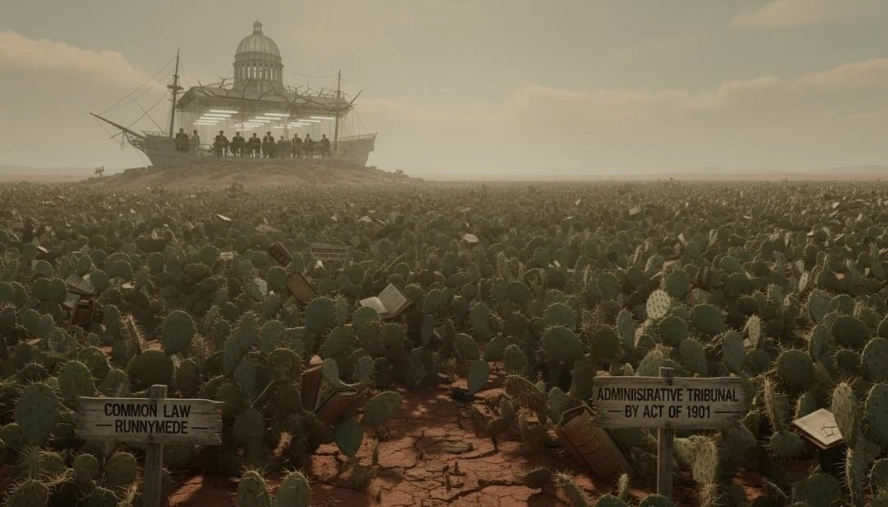
"Across the Darling Downs it went, across the Liverpool Plains,
It swallowed up the open runs, it swallowed up the rains.
It thickened into walls of green that no man’s horse could breach,
It took the land the selectors held and all beyond their reach."
This ballad is written in the cadence of Banjo Paterson—the long rolling line, the sardonic refrain, the plain speech of working men—and spans three moments that shaped the world we now inhabit. The first is Runnymede, 1215, where the barons of England forced King John to seal the Magna Carta and acknowledge that no sovereign stands above the law. The second is 1788, when the First Fleet arrived on Australian shores carrying, among its cargo, a cutting of prickly pear (Opuntia stricta). The third is 1901, when the Commonwealth of Australia was constituted not by its own people but by an Act of the British Parliament. Running beneath all three, unspoken but present, is the shadow of 1688—the Bill of Rights—and the long, slow inversion of the sovereignty it was meant to protect.
The prickly pear is the poem’s central figure. Introduced as a useful thing, ignored for a century, it eventually consumed sixty million acres of eastern Australia—self-replicating, impenetrable, and indifferent to every boundary set against it. It serves here as a metaphor in two senses. First, for the gradual erosion of the principles Magna Carta established: trial by jury, habeas corpus, the natural law tribunal, and the sovereignty of the individual over their own person—each quietly displaced by the thickening green of statute, regulation, and delegated authority. Second, and more broadly, for the creeping collectivist mindset that drives that displacement: the assumption that the individual exists to serve the system, rather than the system existing to serve the individual.
Paterson’s voice suits this subject precisely. His verse was never decorative. It carried the weight of land and labour and ordinary men pushed to the edge of what they could bear. That cadence—sardonic, unhurried, plain—is the natural vessel for this particular dread: the dread not of sudden catastrophe, but of something slow and green and relentless, drawing the last sustenance from the ground it has long since made its own.
The Pear, The Charter & The Creeping Green
Chris and Claude · 2026
Open Here...